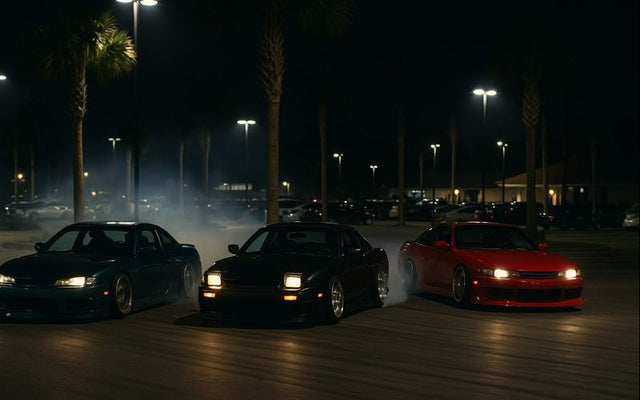
In the demanding realm of today's pro-level oversteer competition, victory is far more than exclusively a function of raw engine power or pilot aggression. Instead, it is now a multifaceted engineering challenge which demands a scrupulous fusion of choosing a proven chassis, outfitting it with the highest-quality drift-spec hardware, and, most critically, comprehending its live behavior on the track through sophisticated drift telemetry software. This comprehensive manual functions as your roadmap starting from the very first concept of a project car through to the last data-informed tweaks that elevate a strong machine into a consistent podium finisher. We will thoroughly explore the art and science of vehicle alignment optimization, showing how a advanced suspension tuning tool like a dedicated telemetry system removes approximation and offers unparalleled insight into your vehicle's true performance.
The cornerstone of any exceptional drift machine is, without question, the platform itself. Several platforms have earned legendary status within the international drifting community due to their built-in balance, strong design, and the vast range of performance components available. Picking the correct starting point is the primary and most important selection a driver will make. For instance, the BMW E36 is universally acknowledged as among the best overall cars for drifting of all time. Its almost ideal balanced front-to-rear weight, coupled with a driven rear axle setup and robust straight-six powerplants, establishes a chassis that is simultaneously accessible for novices and highly effective in the possession of a pro driver. The next step of this concept, the E46 model BMW, builds upon these qualities with a increasingly refined frame, broader track for greater high-speed stability, and even increased lock straight from the OEM. A different formidable option in the pro scene is the Corvette C6.
This American track weapon introduces a unique array of advantages to the sideways world, featuring a lightweight alloy chassis, a backwards-positioned gearbox and differential unit that contributes to an ideal weight distribution, and the tremendous torque of a big LS-series V8 engine. This blend makes it an utter force on track, designed of initiating and holding long slides with relatively effortless deployment of throttle. For builders desiring exceptional performance per dollar, the Nissan 350Z rises above as a excellent example. It comes from the manufacturer with a stiff body structure, a decent factory locking differential, and the responsive VQ35DE powerplant that delivers ample horsepower and torque for mastering and moving up in the sport. Its newer version, the Nissan Z34, offers additional improvements in body strength, steering geometry, and overall powerplant performance, cementing its position as a popular pick among serious competitors. Additional iconic cars that deserve attention encompass the lightweight unique FC generation RX-7, the most popular S13 Silvia/240SX, the American SN95 generation Mustang, the modern E90 3 Series, and the compact yet surprisingly fun and instructive Mazda MX-5. Each of these chassis provides a distinct palette of characteristics, difficulties, and possibilities, but they all share the core components necessary to be transformed into a capable drift machine.
However, picking the optimal platform is just the starting point. To access the complete performance of every of these machines, major changes to the steering geometry and suspension systems are absolutely non-negotiable. This is where the world of performance drift-spec hardware becomes critical view. The one most impactful modification for a dedicated drift car is the installation of a drift-spec angle modification kit. These engineered systems, like those developed by industry leaders like SLR, are created to dramatically enhance the vehicle's maximum lock-to-lock rotation. A OEM road car is extremely constrained in how far its front wheels can turn, a engineering compromise for on-road use. In drifting, however, extreme opposite lock is continuously necessary to control and hold a drift. An steering kit replaces the factory steering knuckles, tie rods, and sometimes suspension arms with parts that enable the front tires to achieve angles in excess of 70 or even 80 °, compared to a normal OEM setting of around 40 to 50 °.
This vastly expanded capability provides the operator with significantly greater authority during a slide, allowing it to be much easier to begin a drift, sustain it through a sweeping turn, and change fluidly from one direction to the opposite. The contrast in controllability is nothing short of profound. Coupled with a correctly specified steering kit is the equally vital upgrade to the chassis's damping system. Off-the-shelf or including high-end road coilovers are simply not engineered for the specific and harsh requirements of drifting. A dedicated pair of suspension units is crucial. These specialized coilovers incorporate custom valving and spring strength that are tuned for the extreme mass transition that is inherent of drifting. When a driver initiates a angle, the car's inertia is thrown violently to the outside of the bend. Correct drift-spec dampers manage this shift in a predictable way, permitting the chassis to stabilize promptly and giving the operator clear response through the steering wheel and cockpit. They also allow for precise tuning of ride height, damping rate, and weight balance, which are all key parts of optimizing the car's behavior to a particular circuit or competition approach. In combination, a high-quality angle modification system and a correctly chosen set of drift-spec coilovers form the undeniable physical foundation upon which all subsequent optimization is constructed.
Once the fundamental components is in place, the subsequent essential stage in the project is the precise tuning of the car's wheel angles. This is the world of chassis dynamics adjustment, a methodology that can feel overwhelmingly complex to the beginner but is, in practice, the defining factor to turning a set of capable components into a unified and consistent vehicle. The most critical parameter of tuning for oversteer is definitely camber angle. Camber is the angle of the wheel relative to the vertical axis when looked at from the forward of the chassis. If the upper part of the wheel is tilted towards the chassis, this is referred to as camber-in. For drifting, negative camber on the front wheels is generally used and is regarded as necessary. The logic is intrinsically related to tire contact.
When a chassis is going around a bend at limit sideways angles, the frame rolls toward the outside of the bend. This chassis roll makes the outside front wheel to diminish its ideal contact patch with the asphalt. By adding negative camber, the tire is pre-leaned to counteract this lean. As the chassis rolls into the turn, the outside front tire gains a better contact patch with the track, increasing its grip at the precise moment when it is needed most for control. Commonly, front camber settings for a dedicated drift car range from approximately -3 degrees to as much as -5 degrees or even beyond, contingent on the parameters of the car configuration, tire type, and pilot preference. The back tires also utilize inward lean, but the angles are generally more conservative and subtler than the front axle. Excessive inward lean at the back can cause the vehicle to extremely loose and challenging to control on throttle input, as it reduces the available contact patch of the powered tires during forward acceleration. Hence, rear axle adjustments are frequently in the vicinity of -1 degree to -3 degrees, finding a delicate equilibrium between providing sufficient cornering bite to aid in initiating and maintaining the slide while still maintaining effective grip for acceleration the bend. alignment is just one component of the broader suspension geometry equation, which also involves toe angle, caster angle, and bump steer modification.
Toe refers to the angle of the tires when looked at from the top. Positive toe means the front edges of the wheels are nearer together than the trailing edges, while toe-out means the reverse. For oversteer, a small amount of front axle toe-out is commonly employed to improve the turn-in directional reaction, making the car feel more nimble and eager to start a slide. Rear toe angle is usually set to neutral or a extremely minute amount of toe-in to foster stability under throttle. caster angle is the longitudinal or rearward inclination of the steering axis when looked at from the lateral of the car. More caster improves self-centering and high-velocity solidity, and it additionally increases camber gain during steering, which is very beneficial. Tuning these parameters is a intricate interplay where a modification to one value can and will influence the other settings. The conventional approach for setting a vehicle's alignment for sliding has historically been a tedious endeavor of experimentation and feeling. A driver or engineering group would apply a adjustment based on a hunch, test the chassis on track, rely on the driver's subjective perception and feedback, and then make a further tweak. This process would iterate over and over until the vehicle felt "acceptable" or the available track session was exhausted. This approach is not just exceptionally wasteful in terms of man-hours and resources, but it is also fundamentally imprecise.
Human perception is a infamously inconsistent metric, affected by many variables such as fatigue, changing track grip levels, ambient heat, and just the mood of the operator on that given session. What feels "oversteery" on one lap might feel "tight" on the subsequent run, causing confusing information and frustrating tweaks. This age-old problem in car suspension tuning is specifically where modern technology has made its mark to transform the methodology.
The advent and application of specialized drift telemetry software has ushered in a new era for building and optimizing high-performance sliding vehicles. This new generation of tools, exemplified by cutting-edge products like modern telemetry hardware, work by physically recording the live dynamic behavior of the vehicle as it is operated on the track. In contrast to using personal impression, these tools collect measurable data on critical factors such as damper compression and extension, corner velocities, G-force loading, steering angle, and driver input position. This collected telemetry is then processed by advanced algorithms that can plot and decode the information in a clear way. For the very first time, drivers and builders can see exactly what the car is doing at any given moment of a slide. This function revolutionizes the entire suspension tuning process. Think about the particular goal of optimizing the front camber for a specific chassis. Rather than making a adjustment from -3 degrees to -3.5 degrees and then testing several passes suspension tuning tool to try and "perceive" a difference, a telemetry system can deliver real-time and clear information. The application can indicate visually how the suspension's loading is performing during the most important stages of a angle: the initial flick, holding the angle, and transition. It can reveal if the present angle is permitting the outside front tire to maintain optimal contact or if the rubber is working inefficiently on its external shoulder.
The software can subsequently suggest fact-based recommendations for modification. Perhaps the data reveals that the outside front tire is still overworking its edge at -3.5 degrees of camber, suggesting that even more negative camber, say -4 degrees, might be advantageous. On the other hand, the data might show that the tire is not reaching optimal operating temp or that the inside shoulder is wearing unevenly, which could suggest that there is overly aggressive angle and a small reduction back to -3.2 degrees would be more efficient. This degree of granularity and practical insight was completely unimaginable in the era of solely seat-of-the-pants tuning.
The impact of using a advanced vehicle dynamics tool reaches well beyond just setting camber angles. It functions as an priceless damper adjustment manual that is specific to your exact car. When setting the rebound and compression values on your coilovers, instead of using general advice or replicating another team's settings, you can utilize the telemetry to observe how the car is behaving in reaction to your changes. The software can graph the wheel movement trace over a run, revealing if the shocks are managing the weight transfer optimally or if they are causing the car to oscillate excessively after a transition. It can help in diagnosing problems like hitting the bump drift telemetry software stops or topping out, permitting you to make educated choices to preload settings, damping rates, or ride height. This approach translates just as well to the detailed task of suspension geometry optimization. In addition to camber angle, the tool can provide drift telemetry software data into how modifications to toe and caster angle are affecting the vehicle's handling during specific parts of a drift. For example, it can allow you to determine the optimal amount of front toe out for your specific steering setup and competition approach by analyzing the quickness of turn-in response and the consistency of the chassis at full lock. This makes the system an exceptionally powerful performance optimization handbook that is actively updated by the live performance of your personal vehicle on the circuit. It moves the complete endeavor from a dark art into a scientific engineering exercise.
Furthermore, the value of a tool like data acquisition is in no way restricted to professional tuners with extensive resources. For the club-level driver, it functions as an incredible force multiplier. It effectively provides the builder with the insight of a professional suspension specialist without requiring the typical cost. It accelerates the learning curve by providing definitive directions to challenges that would normally take years of trial and error to understand. A driver can learn how their specific chassis responds to different inputs, building a deeper understanding of vehicle dynamics in the process. It also democratizes high-level suspension engineering concepts, allowing anyone with the drive to refine their machine to accomplish it in a efficient and successful way. This is especially valuable in a discipline like sliding, where setup knowledge has in the past been a highly secretive advantage among professional drivers. Today, that capability can be in the garage of any dedicated builder.
In the final analysis, the path to engineering and tuning the ideal high-performance drift machine is a multi-faceted endeavor that seamlessly combines time-honored hardware wisdom with revolutionary digital technology. It begins with the informed pick of a capable platform, followed by the installation of critical competition parts like high-performance steering angle kits and correctly valved drift-spec suspension units. The build then progresses into the detailed stage of chassis dynamics adjustment, where values like camber angle, toe, and caster angle are carefully set to match the chassis's modified capabilities and the pilot's specific style. The final step, and what truly separates the today's methodology from the past, is the use of a advanced vehicle dynamics tool. This tool eradicates the uncertainty and trial and error of solely feel-based tuning by giving empirical, live data on how the chassis is really functioning. It serves as an incredible suspension tuning tool, a actionable coilover setup manual, and a comprehensive performance analyzer. In unison, this complete approach ensures that every aspect of the drift machine—from the selection of the car to the last click on the damper—is optimized for ultimate competitiveness on the competition venue. It represents the full maturation of the art of oversteer driving, bridging raw car control with data-informed chassis dynamics to build the most competitive machines attainable.